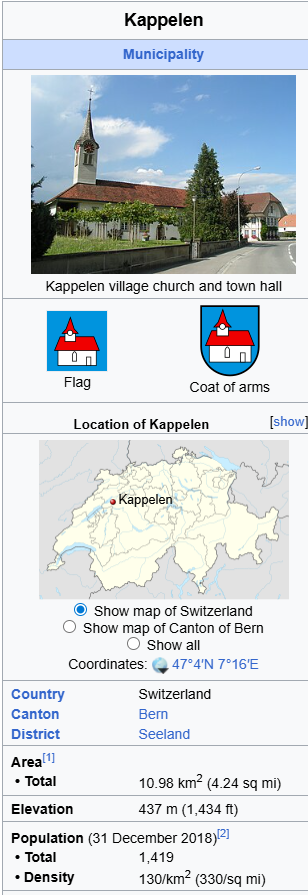
The surname Moeri (or Möri) is common in the canton of Bern, Switzerland even today. The canton of Bern began as a city-state way back in 1191 and joined the Swiss Confederacy in 1353. It’s roots go even further back, with the earliest human settlements dated back to the Neolithic period (10,000 BC – 2200 BC). Engehalbinsel was founded around 300 BCE, and it is believed to have been one of the 12 oppida (fortified towns) of the Helvetii that Julius Caesar described in his commentaries on the Gallic Wars. The village of Kappelen lies on an ancient Roman road between Aventicum and Petinesca.
In 1528 Bern became Protestant when a Protestant majority in the city council led the official conversion of the canton to Protestantism resulting in no official Catholic churches in Bern until after 1858.
The name Möri is spelled in various ways in America, often Morey, Moery, but also Mury.
My 5x great grandfather, Ulrich Möri was born about 1763 in Kappelen, Switzerland in the canton of Bern. It’s a small community with a population of about 1400 people today (panoramic view of today’s Kappelen) and only 239 in 1764. In the 1760s noble families collected taxes from the workers of the land who mainly lived in poverty. I found a reference to an Ulrich Möri who was the “honorable church marshal” in Kappelen in the Bernese newspaper “Berner Wochenblatt” in 1824 (https://www.e-newspaperarchives.ch/?a=d&d=BWB18240703-01.2.13) Ulrich does seem to be a repeated name through the generations, so it may or may not have been in reference to my 5x great grandfather as I don’t know his date of death. The records for Kappelen are in handwritten German, but they list Ulrich’s wife as Anna Jenni. I found a reference to an Anna Barbara Jenni who was arrested for rolling a drunk in 1872, but obviously those dates make it unlikely it’s the same woman.
My 4x great grandfather, Benedicht Möri was born 5 June 1783 in Kappelen. The area was invaded by the French in 1798 during the French revolutionary wars and the Old Swiss Confederacy collapsed from the invasion and the Helvetic Revolution, reforming as a sister republic to the French First Republic, the Helvetic Republic.
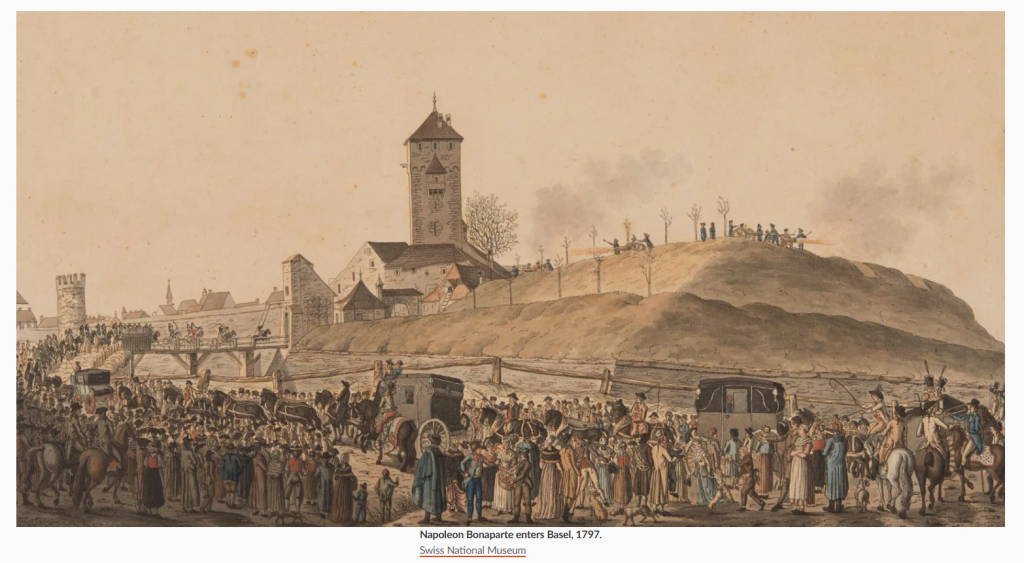
The take over was mostly bloodless, though the Battle of Grauholz occured just a dozen miles from Kappelen in March of 1798. Essentially the German speaking people of the canton of Bern were not as receptive to the idea of a French take over as those from other parts of Switzerland. The Bernese army was hugely outnumbered with about 6,400 Bernese facing 18,000 French. The locals, including women, old men and even children from the rural area joined them in battle to defend their homes from the French invaders. They held on for about two and half hours before bands of Bernese broke off in surrender. The small village of nearby Bollingen reported 27 dead. Overall about 2 thousand Bernese died. I have no idea if any Mori’s were involved in the war, but Benedict would have come of age in the thick of it. Napoleon Bonaparte, a general during the invasion, then First Consul during the restructuring was popular in other areas of Switzerland, but not Bern.
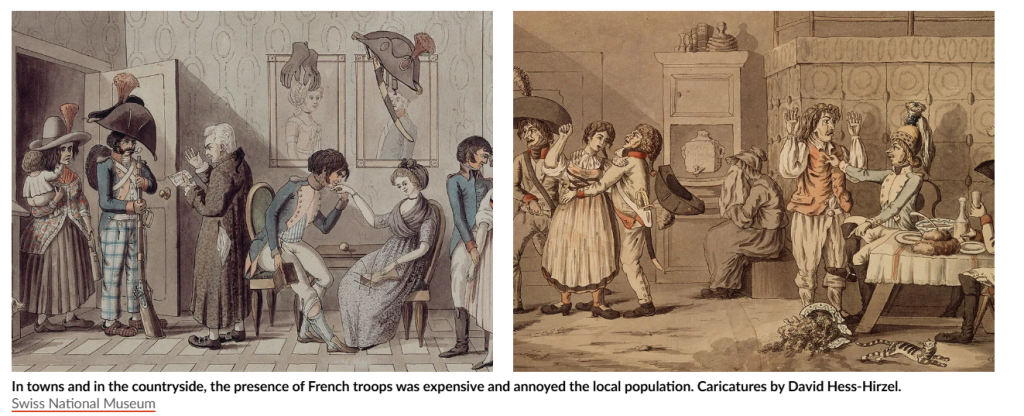
In late July 1802 the French forces withdrew from the country and in August there was an uprising that led to a civil war known as the Stecklikrieg or ‘War of Sticks’, so called because many were armed only with improvised weapons and everyday objects. The Bernese were essentially fighting against equal rights for town and country. Bern had always had the most power of all the Cantons and they didn’t want to give it up. Karl Ludwig Stettler from Bern, who fought for the federalist troops in 1802, wrote in his diary that Bern opposed Schwyz’s proposal as it meant “abolishing all privileges and introducing a democratic constitution”. He said the people of Bern had not taken up arms “to introduce rural democracy and popular government”. In 1802 Bern wanted to turn back the clock and bring back unequal patrician rule. The war ended when Napoleon, now First Consul of France, offered to mediate and in fact his forces re-invaded until a compromise, the February 1803 Act of Mediation, ended the Helvetic Republic and reestablished a Confederacy. The cantons would be given equal status and subject territories and patrician rule would be consigned to the past.
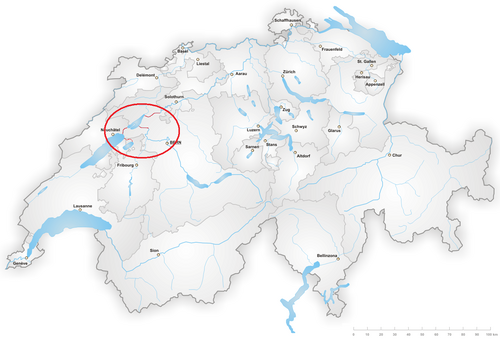
I don’t know a lot about the early life of Benedict, though I did find a reference to a Benedict Mori who was a saddler in Kappelen forced to sell his estate at auction because he was found guilty of gross fraud and forgery in 1810. Which would explain why he didn’t marry until 4 Feb 1825, at the age of 41. Benedict married 20 year old Maria Magdelena Scheurer from the nearby village of Schüpfen. Collectively this area is part of the Seeland district, at the foot of the Jura Mountains. It was a swampy area containing the 3 Lakes of Morat, Neuchâtel, and Bienne and was a floodplain for the Aare river (a tributary of the Rhine). Starting in 1865 the country started redirecting the rivers and lakes to dry the swamps and create fertile agricultural land.
Benedict and Maria had 5 sons in the 8 years between 1825 and 1833, their youngest son, Rudolph is my 3x great grandfather. Benedict died in May of 1833 at just 49 years old, a month before Rudolph was born. Maria survived her husband for more than 40 years, dying in 1874 at the age of 70.
While for a long time emigration from Switzerland was individual groups or persons, Swiss immigration to the US increased sharply in the middle of the 19th century. Between 1851 and 1880, the American authorities registered over 75,000 people from Switzerland. And in the following ten years or so, another 80,000 Swiss emigrated to the US.
The wave of emigration was triggered by various factors, says historian Aragai. “One reason is simple: poverty in Switzerland. At first, it was mainly poor people who made the journey.” It was not uncommon for them to be encouraged to leave Switzerland by their home community – in some cases they were even supported financially. Many countries became annoyed at Switzerland for sending their poor to their countries. I found at least one Möri, Maria Möri, wife of Johanne Möri, who was subjected to Behütung, or guardianship.
In the 1850s, Switzerland’s “enforced welfare measures” were part of a system of social control, predominantly at the cantonal levels. Rooted in older poor-relief laws, authorities placed children from impoverished families into forced labor, under what became known as the Verdingkinder (indentured children) system. But it was not limited to children. Adult women were also subjected to guardianship, really anyone the council deemed to be living “a bad life” could be forced into a new home, a new job, often they were given passage out of the area all together.
My 3x great grandfather was Rudolph. I found a reference to a Rudolph Möri who was a teacher in Epsach acting as the guarantor for Bendecht Möri in renting a home in the “Seeländer Bote” (Seelander Messenger). Epsach is a village just 6 km from Kappelen, but as there are multiple lines of this family in this area it may or may not be our Rudolph. In 1826 the “Berner Wochenblatt” includes him in a list of “governors” in Kappelen. We know he married in Kappelen in 1860 and had four children in Switzerland before they decided to make the voyage to America. This is confirmed by a DNA match through one of his children born in Switzerland. His older brother, Johann Ulrich Möri, a shoemaker, came to America in 1859 on the ship Washington, and settled in Pennsylvania. Rudolph and his family came on the ship Mercury in 1867. His wife Maria died shortly after in 1870 in Metamora, Illinois. He then married my 3x great grandmother, a German immigrant, Kate Frank in 1875.
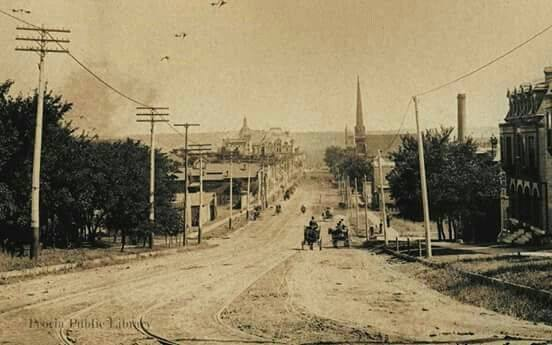
In the 1875 City of Peoria Directory he is listed as having a tailor shop at 225 Main Street in Peoria.
Two years later, in 1877, my 2x great grandmother, Anna was born. Kate and Rudolph had 7 children in eleven years, three dying in infancy. The 1900 census shows him and Kate living with his adult daughter from his first wife, Mary, now 39, his child with Kate, George only 11 years old, his married adult daughter Katie Zimmerman, now 19 and her husband Frank. Rudolph is listed as working as a tailor in Peoria until 1903 when he was 70 years old and he died in March of 1907 of chronic emphysema at the age of 73.
Anna married James Taylor in 1895. Their first son died at 11 months of age. My great grandmother, Ruth Taylor, was born 4 months later, followed by her sister Margaret the following year. Anna and James split up and Anna married Frank Owen in Nov 1899.
In 1900 Katie Frank Moeri died at the age of 64. Three years later Anna also died, of sepsis following a surgery. Rudolph with his chronic emphysema outlived both of them.
Ruth and Margaret lived with their father and his new wife for ten years until at the age of 15 and 14 James died and Ruth and Margaret were orphaned. I’ve detailed Ruth’s story in previous blogs.