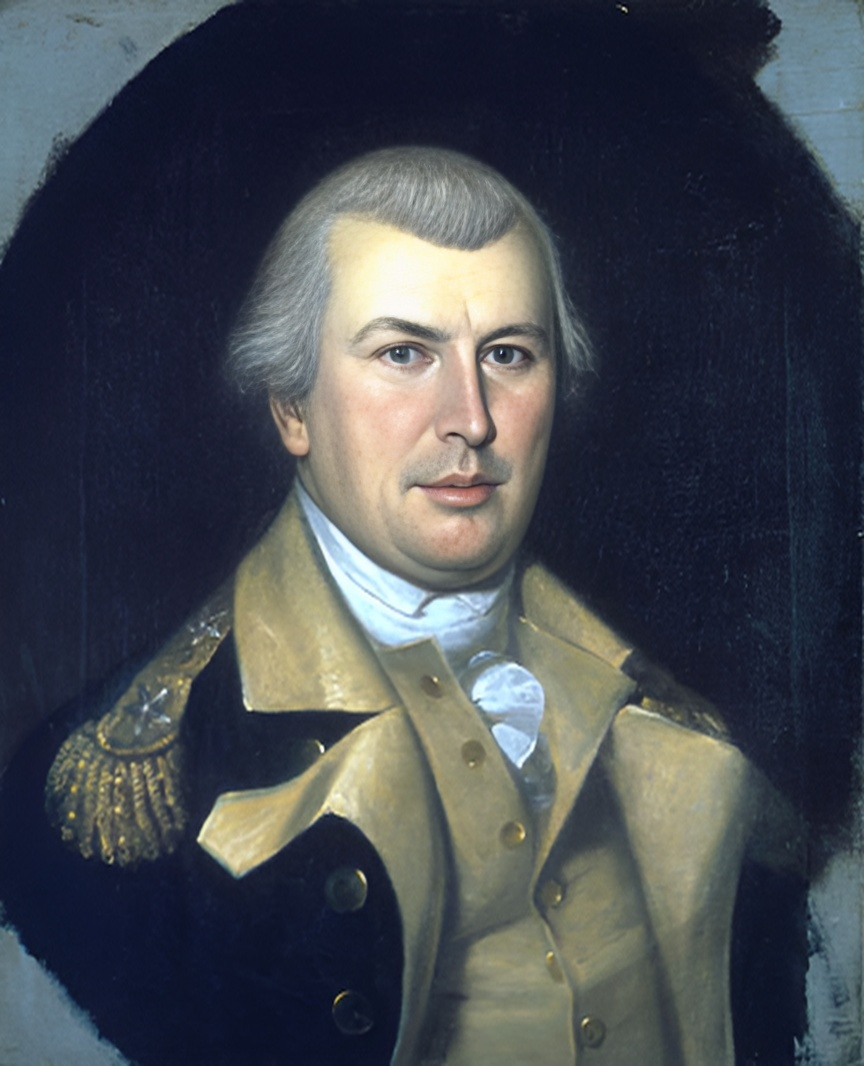
I was watching Ken Burns’ new documentary on the Revolutionary War and they mention and quote General Nathanael Greene quite often. I remembered when previously writing a post about the Greene family of Rhode Island, reading that this General was a descendant of the same family so I decided to add him to my family tree.
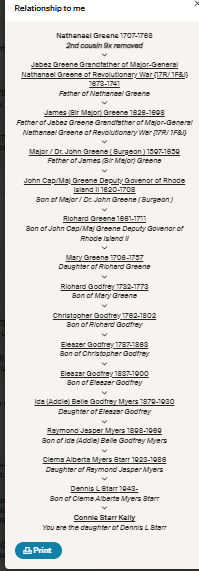
Major General Nathanael Greene was the son of Nathanael Greene, and Mary Mott, born in Potowomut Rhode Island in 1707. Potowomut is just northwest of North Kingstown Rhode Island, where my family stayed on vacation last June. Both of his parents are my 2nd cousins, from 2 different branches of my family tree!
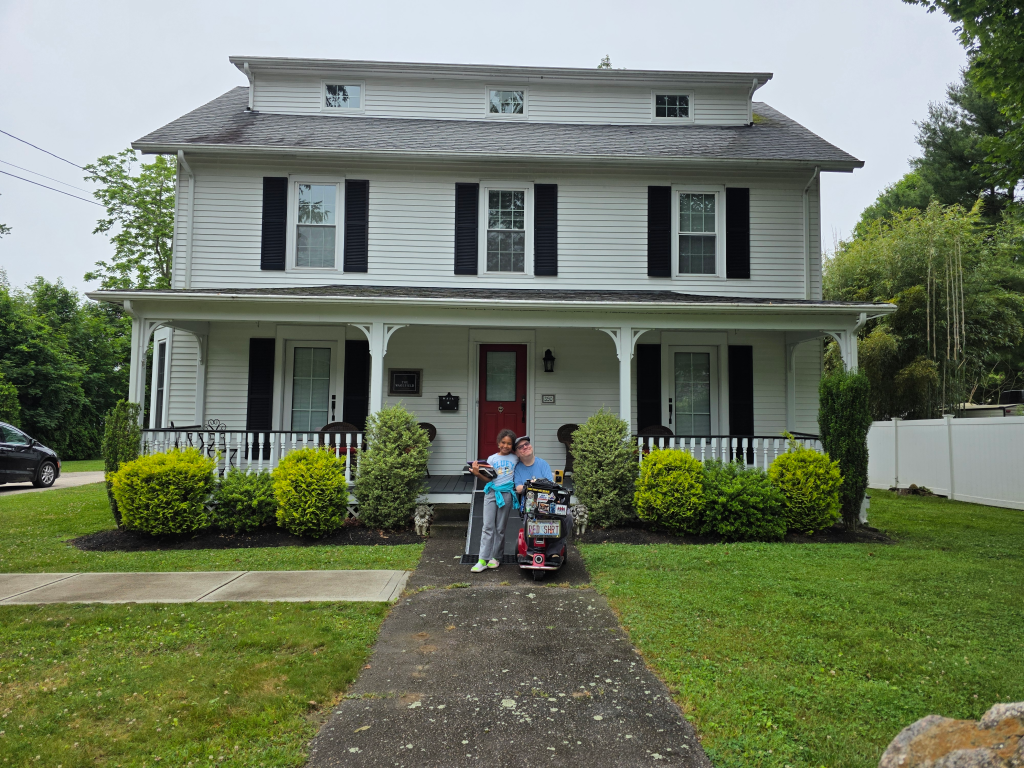
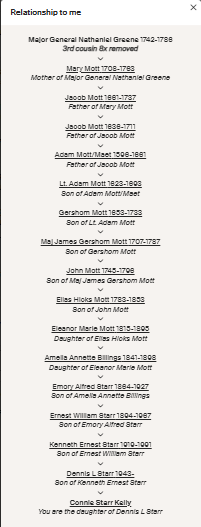
He is my 3rd cousin, 8x removed.
If you haven’t watched the documentary on the Revolutionary War you really should, but here’s a recap of Major General Greene’s actions during the war (From georgiaencyclopedia.org)
Military Career
In 1774 Greene helped form the Kentish Guards, a Rhode Island militia unit. He was only allowed to serve as a private in the group, however, because of a slight limp that he had had since birth. Greene later commanded the Rhode Island militia and became a brigadier general in the Continental army, acting in the siege of Boston in 1776. His performance impressed General George Washington, who gave Greene the command of Boston after the British evacuated the city. At the age of thirty-four Greene was promoted to become the youngest major general in the Continental army up to that time. (Four months later, the Marquis de Lafayette became a major general at the age of nineteen.) He participated in the Battles of Trenton in New Jersey and Brandywine and Germantown in Pennsylvania, and acted as quartermaster general at Valley Forge, Pennsylvania.

The Southern Campaign
In 1780 Washington gave Greene the arduous task of leading the feeble Revolutionary army of the South. The army had already had three commanders, whose failures had left the South in a weak and uncertain state. Greene and his men would face the most able of the British generals, Lieutenant General Charles Earl Cornwallis. His large and well-trained army was a daunting challenge to Greene’s small, inexperienced, and poorly supplied Continental forces.

Greene led a bold and ingenious fight against British occupation in the South. While he knew that his army was not capable of winning any large or decisive battles, Greene used the small size of his forces to make sudden, brief attacks on the conspicuous and slow-moving British army. He also daringly divided and thus weakened his army, forcing Cornwallis to do the same. Greene knew that such a move would have grave consequences for the British, greatly reducing their strength. He then led his men in a retreat that forced Cornwallis to follow the Continental army far away from the British supply base in Charleston, South Carolina. Through tactics such as these the British army became a less formidable force.
His grandfather, Jabez is the son of James Greene, my 9x great granduncle.
Geni.com includes this bio on James Greene: He was a member of the General Assembly of the Colony, being commissioner under the first charter and deputy and assistant under the second (1663) for ten years, between 1660 and 1675. He was considered a man of much practical sagacity. On the outbreak of the Indian war, 1675-76, the inhabitants of Warwick left the town and Mr. Greene fled to Portsmouth, and in 1684, having made purchases of Warwick land, he removed to Potowomut, where was an ancient mill, and built his home on the hill near the west bank of the river, overlooking the beautiful lake which furnished the water power for the forge which his grandsons (sons of Jabez) established for making anchors and other forms of iron work. This became a notable industry in Colonial times and in the early days of the Republic. The interests of the forge “were enhanced by the revival after peace existed between England and her emancipated colonies, and this became the pioneer of the more extensive works on the Pawtuxet river, near the western border of the Warwick, known as ‘the Forge’.” The place at Potowomut, where James Greene resided until his death, was the birthplace of his great-grandson, the highly distinguished Nathaniel Greene, of the Revolutionary army, and the residence of his descendants for more than two hundred years.
James’ father was my 10x great grandfather, Dr. John Greene, the main subject of my previous post who immigrated to America from England in 1635.
But I found another connection when adding General Greene to my family tree. His mother, Mary Mott was from Portsmouth, Rhode Island. This also rang a bell for me. I traced her lineage and found she too is my 2nd cousin 9x removed!
The Greene family are ancestors on my father’s mother’s side. The Mott’s are ancestors on my father’s father’s side.
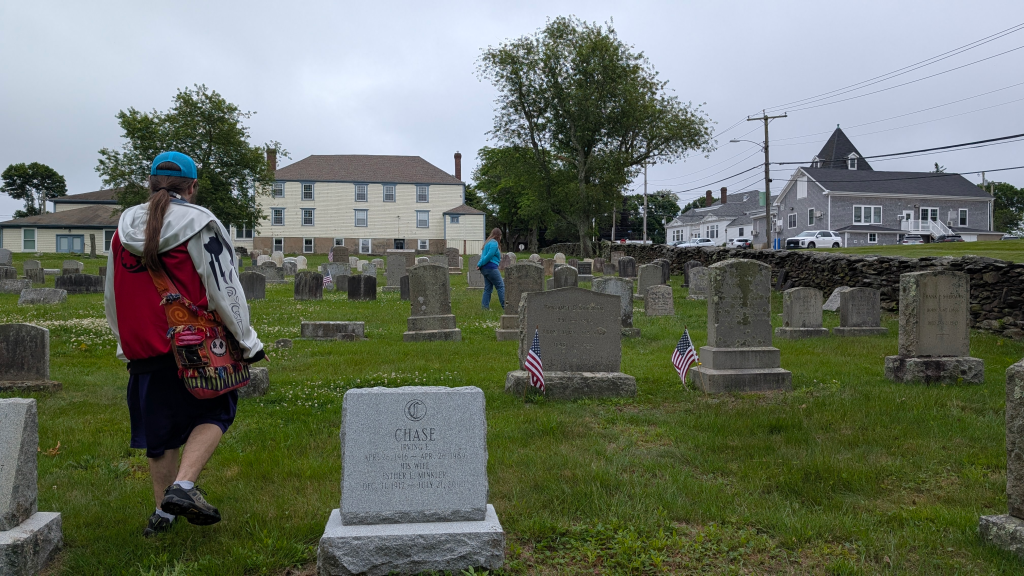
Mary Mott was the daughter of Jacob Mott and Rest Perry, born in Warwick Rhode Island in 1708. Elder Jacob Mott was a Quaker minister for 35 years in Newport County Rhode Island. He was the son of Jacob Mott Sr. and Johanna Slocum. Jacob is my 9x great granduncle, the son of Adam Mott- the first Mott to come to America in 1635, the subject of my previous post, https://themroots.com/rabble-rousing-quakers/. On our vacation this past June we visited the site where Adam was buried in Portsmouth, Rhode Island.
It struck me as odd the son of pacifist Quakers would be a Revolutionary War General. I found this interesting history on that also on georgiaencyclopedia.org:
He was brought up in the Quaker church, a faith that denounces warfare. Greene lived a quiet life as a blacksmith in his father’s iron foundry before the war. An avid reader, he developed an early interest in military science, upsetting both his family and the Quaker community.

Greene was elected to the Rhode Island legislature in 1770 and became an eager advocate for American independence from Britain. After attending a military parade in 1773, he was expelled from a Quaker meeting. From then on, Greene chose to separate himself from the faith and became actively involved in military service.

And then there's this:

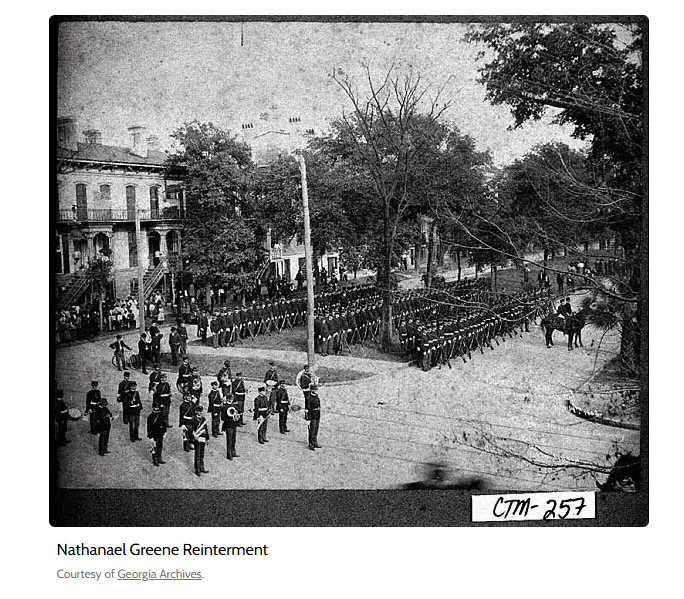
Greene willingly gave much of his personal wealth to help support the war, even sacrificing his Rhode Island home. To thank him for his service during the war, the Georgia government gave Greene a plantation named Mulberry Grove, outside Savannah in Chatham County. He lived on the Mulberry Grove estate for less than a year, troubled by insecure finances; the plantation did not become profitable. Greene died unexpectedly of sunstroke in 1786, at the age of forty-four. Initially buried in Savannah’s Colonial Park Cemetery, Greene was reinterred in 1902 beneath the monument erected in his honor at Johnson Square. The remains of his son, George Washington Greene, are buried there as well.
After Greene’s death, a young Yale University graduate, Eli Whitney, came to Savannah to take a tutoring job. Whitney began working for Greene’s widow, Catharine, and it was at Mulberry Grove that Whitney invented the cotton gin, the machine that revolutionized the production of cotton.
Saba, Natalie. “Nathanael Greene.” New Georgia Encyclopedia, last modified Feb 21, 2018. https://www.georgiaencyclopedia.org/articles/history-archaeology/nathanael-greene-1742-1786/
Leave a Reply